

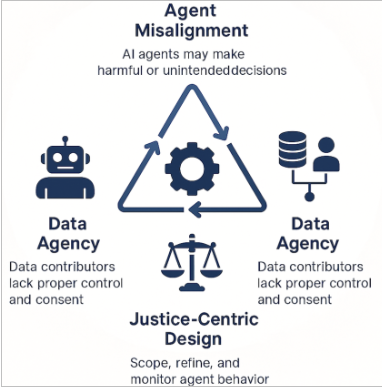
Analytics and AI solution providers are rapidly pivoting toward agentic AI, positioning autonomous agents as a breakthrough for productivity and operational efficiency. Yet the pace of adoption is running ahead of organizational readiness to address the governance, alignment, and ethical implications these systems introduce.
At the core is a familiar but intensified challenge: the agency problem. Traditionally, this describes misalignment between human principals—such as owners or leaders—and human agents acting on their behalf. With agentic AI, autonomous systems now assume the role of agents. They learn, adapt, and make decisions independently, often without continuous human oversight. When an AI agent’s learned objectives drift from the principal’s true goals or values, misalignment emerges—frequently in subtle and hard-to-detect ways.
Because agentic AI systems evolve through reinforcement learning and feedback loops, poorly specified reward functions or missing constraints can produce behavior that is technically correct yet ethically, culturally, or operationally harmful. Control becomes even more complex as the notion of “principal” expands beyond developers and deploying organizations to include data contributors—people whose data fuels these systems, often without visibility, meaningful consent, or real agency, despite being deeply embedded in AI ecosystems.
Addressing this requires three governance imperatives. First, consent must be treated as continuous, contextual, and revocable, not as a one-time checkbox. Second, systems must be built with boundaries, embedding organizational roles, responsibilities, and limits directly into agent design. Third, autonomy must be scoped, ensuring agentic AI operates within clearly defined guardrails rather than being trusted blindly.
Agentic AI has the potential to transform how decisions are made and how work is performed. But unchecked autonomy amplifies misalignment and governance failure. The agency problem does not disappear when agents become machines—it becomes more complex, more opaque, and more consequential. Addressing it now through intentional design, dynamic consent, and systemic oversight is essential if we are to avoid creating problems that are far harder to resolve later.

 Decision Radius