

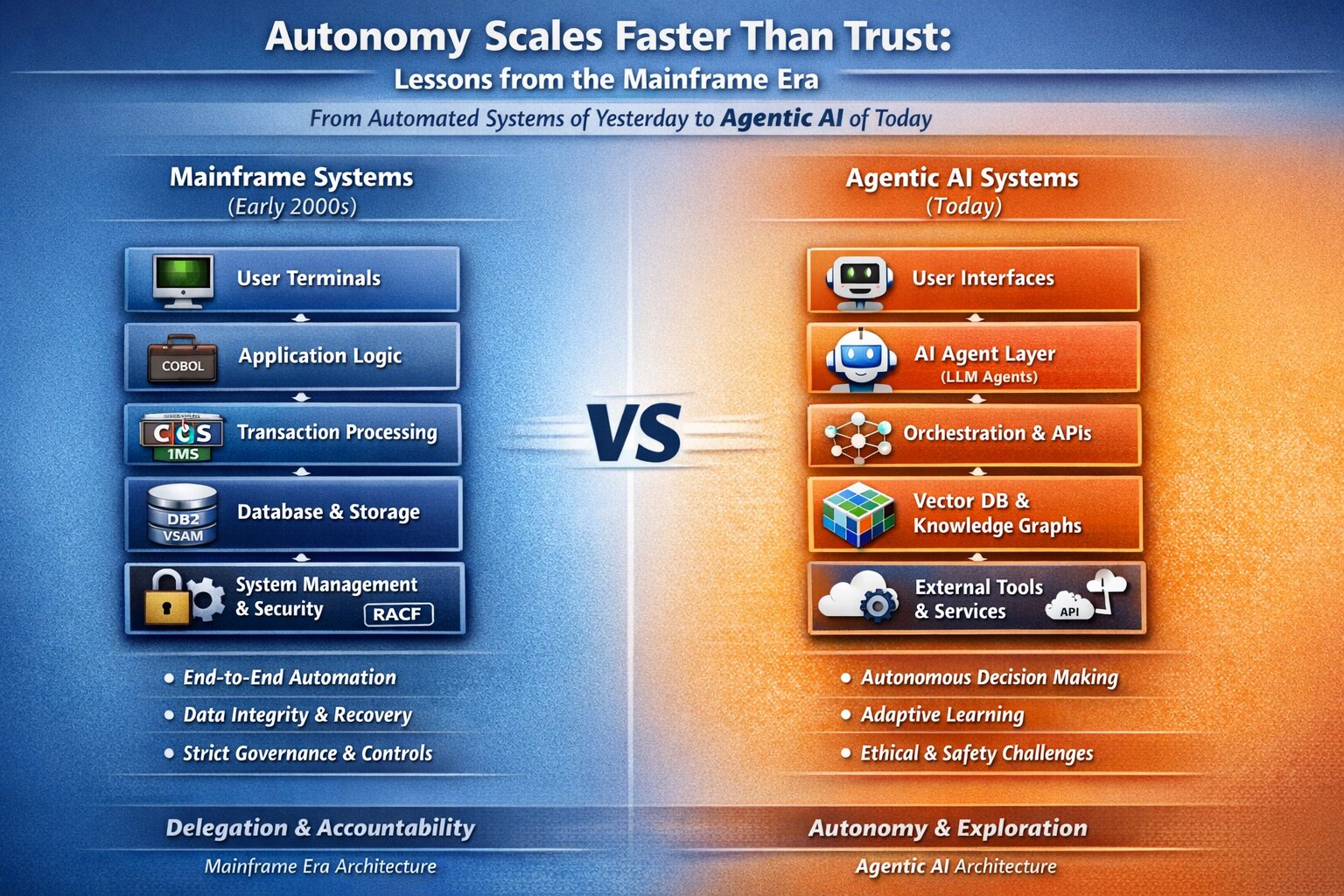
As enterprises rush towards Agentic AI, leaders are confronting an uncomfortable truth: autonomy scales far faster than trust. What’s often missing from today’s conversations is that enterprises have already built autonomous systems successfully – decades before LLMs existed.
For those of us who built and ran enterprise systems on mainframes in the early 2000s, systems already ran end-to-end workflows with minimal human intervention — from transaction initiation to data persistence, reconciliation, and recovery.
Mainframes were delegation systems with accountability, not dumb machines. Here’s a comparison of a typical full stack application in the Mainframe era with architectures being deployed for Agentic AI.
Full-Stack Then vs Full-Stack Now
| Full Stack | |||
| Characteristic | Purpose | Mainframe | Agentic AI |
| User Interface | Controlled human input | ADSO / CICS | Web / Chat |
| Business Logic | Deterministic business rules | COBOL | Microservices / Agents / RAG |
| Transaction Control & Orchestration | Workflow sequencing | CICS | LangGraph / workflows |
| State / Data | Durable system memory | IMS / IDMS / DB2 | Cloud Dws / Vectors |
| Operations | Ops with fault tolerance, risk containment & recovery | JCL, schedulers, Checkpoints, restarts | MLOps / AIOps |
Mainframe and Agentic AI systems are different on the following characteristics:
| Dimension | Mainframe Systems | Agentic AI Systems |
|---|---|---|
| Intelligence | Rule-based | Probabilistic / learned |
| Decision logic | Deterministic | Contextual & adaptive |
| Control | Centralized | Distributed |
| Failure mode | Known & bounded | Silent / emergent |
| Explainability | High | Often low |
With Mainframes, autonomy existed — but intelligence was predefined, not adaptive. While, Agentic AI is often presented as a radical break from enterprise computing. In reality, many of its core ideas were already present in mainframe-era systems — just expressed differently.
Here are the similarities between Mainframes and Agentic AI applications.
| Agentic AI | Mainframe Era Parallel |
|---|---|
| Autonomous workflows | JCL job chains |
| Scheduled agents | Batch windows |
| Event-driven agents | CICS transactions |
| State consistency | IMS / IDMS integrity |
| Guardrails | VSAM locking |
| Identity & authorization | RACF security |
| Human in the loop | CICS operators, Job schedulers, exception queues |
With Mainframes, Governance was the Architecture, Not an Afterthought. Mainframes had robust governance principles with:
- Change control (JCL, PROD promotion)
- Separation of duties
- Audit trails by default
- Deterministic replay
Key ideas from Mainframes which emphasized their reliability are:
| Mainframe Concept | Functional Principle |
|---|---|
| Batch jobs (JCL) | Pure functions |
| Stateless transactions (CICS) | Idempotency |
| Input → Output programs | Referential transparency |
| Strong schemas (COBOL copybooks) | Type safety |
| Deterministic execution | Predictability |
Mainframe programs were purely functional within constraints, ensuring side effects were tightly controlled, Failure modes were known and predictable. Mainframes optimized for correctness, reliability, and scale, not experimentation.
In contrast, recent examples of Modern AI systems overstepping policy or escalating incorrectly have been highlighted [1, 2]. As a result enterprises attempt to bolt governance on after deployment; precisely the opposite of how enterprise systems earned trust historically. Agentic AI is forcing us to rediscover functional boundaries w.r.t what an agent can do, what it must not do and where human approval is required.
What changed (mid 1990’s onwards):
- Object orientation
- Stateful services
- Layered abstractions
- Tight coupling
What we gained:
- Developer velocity
- UI-centric thinking
- Rapid iteration
What we lost:
- Loss of execution ownership
- Loss of predictable failure modes
- Loss of discipline around state, responsibility and rollback
- Shift from operational correctnes to demo driven velocity
Speed and abstraction replaced predictability as a trade-off. Agentic AI is now forcing a relook at the trade-off.
- Agents = functional program units with intent
- Orchestration = modern transaction managers
- Human-in-the-loop = evolved operations control
- Memory, tools, policies = new forms of state
Hence. what we call “Agentic AI” today is not just a rupture — it is a return. Enterprises are rediscovering:
- Determinism
- Stateless execution
- Idempotent processes
- Orchestrated workflows
These were foundational principles of mainframe-era computing.With Agentic AI, the intelligence layer changed. The execution philosophy did not.
What Mainframes Teach Us which are relevant Agentic AI Today:
- Delegation requires boundaries
- Autonomy must be predictable, autonomy without governance is reckless
- Human oversight is architectural, not manual
- Trust is earned through boring reliability
- Data integrity beats model cleverness
- Failure modes must be explicit, auditability is non-negotiable
- Observability is not optional
- Human override must exist
The success of Agentic AI will not be determined by model sophistication alone, but by whether organizations remember how to engineer trust.Enterprises that combine artificial intelligence with architectural discipline – clear boundaries, deterministic execution paths, explicit failure modes and human override by design – have greater chances at scaling autonomy safetlyversus those that assume trust instead of engineering it.
Disclaimer: Between 2004 and 2009, the author worked on IBM z/OS platforms, building and operating full-stack applications using COBOL, CICS, ADSO, JCL, REXX, VSAM, IMS, IDMS, and DB2. Opnions in this article are personal and do not necessarily reflect the views of the author’s employer or associates.
References:
Glossary:
| Term | Description |
| ADSO | Application Development System Online – Mainframe tool |
| CICS | Customer Information Control System – Mainframe application |
| COBOL | Common Business Oriented Language – Mainframe Functional Programming Languae |
| DB2 | Database 2 – Relational Database for Mainframes |
| IDMS | Integrated Database Management System – a network & relational database for Mainframe |
| IMS | Information Management System – a hierarchical database for Mainframe |
| JCL | Job Control Language – scripting language for executing batch jobs in Mainframes |
| RAG | Retreival Augmented Generation – capability for Generative AI models |
| REXX | Restructured Extended Executor – general purpose, procedural programming language for Mainframe |
| VSAM | High performance Mainframe file system for organizing and efficiently accessing data |

 Decision Radius